
Children's Book Week 2011
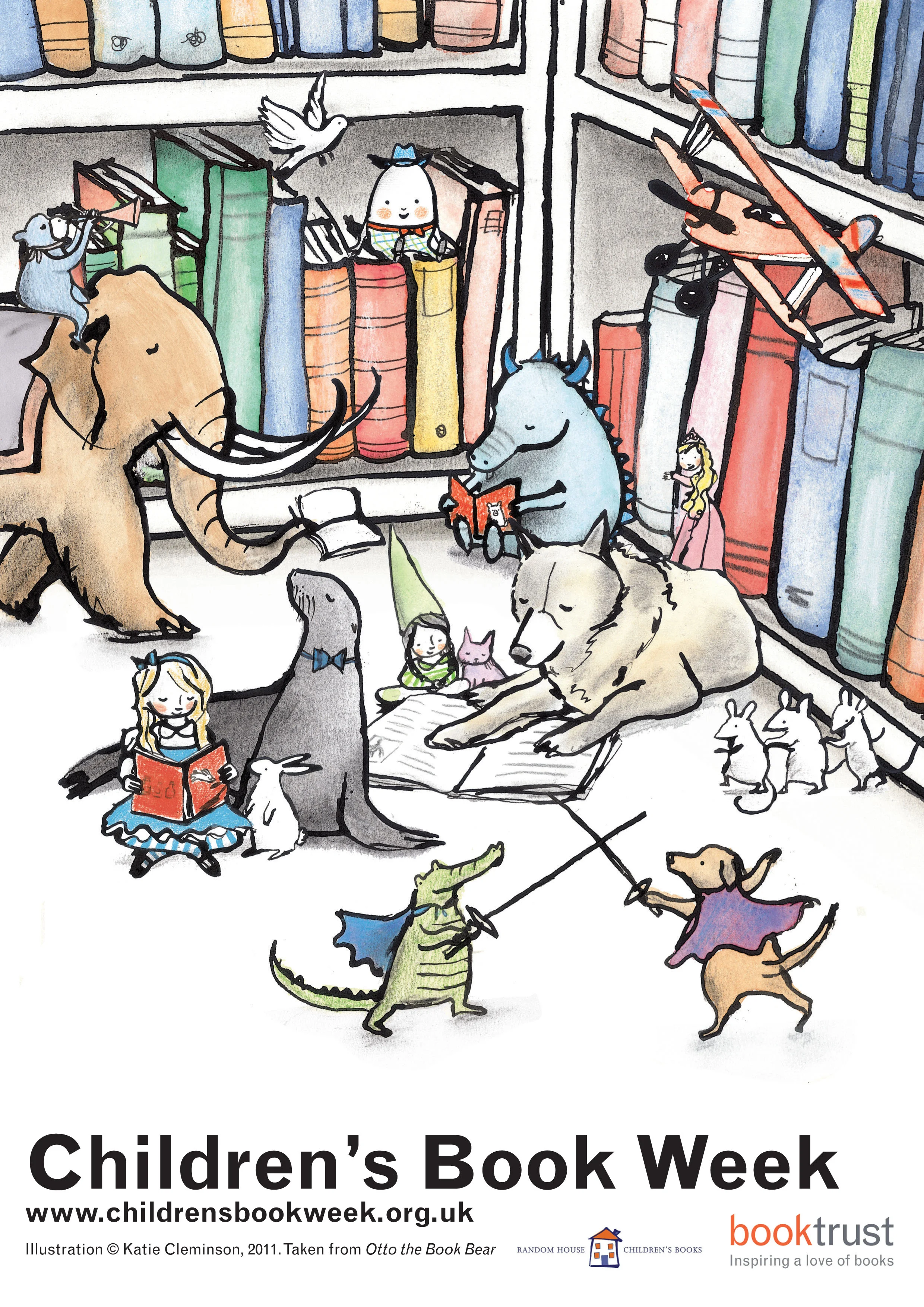
Hurrah! Those wonderful, beautiful people over at Booktrust picked me to be the illustrator for Children's Book Week!
To find out more and to download the poster go to the fantastic Booktrust site.
Desk Love

I absolutely love my desk (no.6), but I remember it took me a long time to find the exact one I wanted. Some of these are expensive choices, but some are quite reasonable.
1. Odyssey Writing Desk 2. Treviso Desk 3. Airia Desk 4. Bourbon Vintage Desk 5. The Orwell Writing Desk


Viviane Schwarz is a Greenaway-shortlisted, Booktrust Best New Illustrator, Roald Dahl Funny Prize-nominated, Author/Illustrator genius. You will probably know her from her fantastic 'There Are Cats In This Book' series, and her new book with Alexis Deacon 'A Place to Call Home'. (if you follow her blog you will also know she has a graphic novel called 'The Sleepwalkers' coming out soon.)
I saw Viv earlier in the year at the London Book Fair, for a Best New Illustrators talk we were both part of, and we had a very interesting disussion about the future of digital books. I've spoken to a few people about this subject, but none so interesting as Viv. So I asked her if she would let me hold a little interview about it for my blog... This will be the first of a series, in which I will ask fellow illustrators for their opinion on a specific subject. I hope you enjoy reading this, I found it fascinating, do let me know your thoughts in the comments box. Thanks again Viv,for taking the time to do this! Click below to read the full interview

Viviane Schwarz is a Greenaway-shortlisted, Booktrust Best New Illustrator, Roald Dahl Funny Prize-nominated, Author/Illustrator genius. You will probably know her from her fantastic 'There Are Cats In This Book' series, and her new book with Alexis Deacon 'A Place to Call Home'. (if you follow her blog you will also know she has a graphic novel called 'The Sleepwalkers' coming out soon.)
I saw Viv earlier in the year at the London Book Fair, for a Best New Illustrators talk we were both part of, and we had a very interesting disussion about the future of digital books. I've spoken to a few people about this subject, but none so interesting as Viv. So I asked her if she would let me hold a little interview about it for my blog... This will be the first of a series, in which I will ask fellow illustrators for their opinion on a specific subject. I hope you enjoy reading this, I found it fascinating, do let me know your thoughts in the comments box. Thanks again Viv,for taking the time to do this!
Digital VS Printed
KC: Do you believe that digital books will replace printed in the future?
VS : Yes, I believe for most uses they will. I expect picture books to hold on for longer than most because it will be a while until child safe technology is available, and also because the tactile qualities of a novelty book are a big plus for small children.

KC : What can printed books offer us that digital can't?
VS : Digital books are still less easy to use. But they have not yet reached their full potential. I expect that we will soon be able to flick through them as fast as through a real book (digital searching isn’t efficient if you can’t think of a useful search term) and annotate them casually.
Still, printed books will always have the added value of being physical objects, and we like to emotionally invest in objects. We like to know that the copy we are holding of a book is the same that we took on some special holiday, or that belonged to someone we cared about, maybe we even like the idea of not knowing who read it before. Physical objects accumulate history. We may have to let go of that, and rethink, value the books for their content, not their emotional history as individual objects. Instead of handing someone a treasured copy, we will just recommend a book. That seems a sad loss, but how great a loss is it really? Personally, I don’t mind at all. I enjoy getting recommendations, and making my own choices. But I understand that many people feel differently.
But individual history is not the only desirable quality of physically printed, bound books that cannot be translated into digital editions.
You might think for example that children’s apps and novelty books are basically the same thing because they both offer interactive, illustrated storytelling. You could say that a printed book is inferior because it cannot reproduce an app, but the app can reproduce the book. Yes, an app could reproduce an interactive book exactly, but it would be absurd. The attraction of a novelty book lies in its restrictions as much as in the surprises it provides. A pop up folding out of a book can teach you about mechanics, and the intricate covering/uncovering processes employed to make a printed book move are enjoyable because they are “tricks”. It’s the difference between watching a magician and watching CGI movie wizardry. You might marvel at a huge moving dragon popping up in an app, but you will accept it as animation and sound. A pop up paper dragon makes you ask: how was this done? and it will give you the answer if you look closely. Apps may encourage children to produce visuals, audio, to tell stories, create movement, but they do not not encourage physical, three dimensional problem solving and invention. Printed books are physically achievable with simple materials, and can be produced by children pretty much unaided. Children will also be able to produce their own apps - but there is great value in keeping them used to non-digital creative skills as well. We still live in a three dimensional, tactile world after all.
In a less obvious way, this also applies to other printed books - printed paper isn’t just a way of storing text.
The design of physical books may elevate the text, working with page turns, layout etc. Much of that is lost in digital books, which need to be formatted flexibly for a range of requirements.
We can read our digital books in a font that the author would have hated, scrolling in a continuous line, comic sans, pink on purple. Does presentation make a difference to information? It makes a difference to how we interpret that information.
There is a lot of work that goes into a book after the text is written and edited. All this is lost, potentially, in a digital book, if the reader doesn’t care for it - locking down the format would lead to all sorts of problems. Short sighted people want large text, and they, as well as people who want pink script on yellow papyrus, will prefer a device and file format that will allow this, and so it will happen.
It’s a tradeoff. We lose sophisticated design - until we learn how to design for this new medium. At the moment, digital books are mostly ugly, like the internet was mostly ugly years ago.
Physical books are an old, beautiful medium. This will be a loss, unless we work at improving the new medium to be beautiful as well as practical. And there will be a niche for the old medium.
The rise of the digital books is a challenge for the printed book - we are starting to notice the features of a book more again, and question how they can justify themselves, what they can add. If there is an endpaper, a physical cover, a headband maybe, a bookmark, page turns, paper stock, illustration, we might as well make them count. I feel I’ve noticed an increase in very desirable books, designed with a lot of care, books that smell great, are printed beautifully, books that celebrate their content. I don’t mean show-off leather bound editions that just make the statement “look, I like this book and wanted to spend extra” but ones that are designed so that every part of it adds to the narrative of story book, strengthens the imaginary world of a fantasy book, or makes a practical book even more so.

I start every book I make by asking myself: what will this be for? That comes before characters, plot, style, anything else. Maybe I want to make a book that makes someone feel less scared of the world. Then the book should maybe be small and sturdy so you can carry it, and with parts that can be personalised to make it yours, or maybe it should have pockets that hold added uplifting material. Maybe it should have space for notes, if I am hoping that the reader will make useful discoveries to beat their fear. Or maybe it should be very large, so big you can hide behind it. Then I think about who or what will inhabit the book, and in what way, and how I want the reader to interact with them, and by what design I can encourage the reader to do so. I imagine and invent my books from the physical end towards the content, not the other way around.
I also believe that if I’ll have a huge tree chopped down to make something, I should have a good reason for it better than just “I like turning paper pages” or “I like the smell of printed books”.
The books that I have produced so far are designed to be physical books, and if I had set out to make digital books, they would have ended up being something else entirely, different stories, different characters, different ideas.
I hope that the pressure on the printed book to deliver a unique experience will continue to produce innovative, beautiful objects.

KC : And, what do you believe digital books will provide the reader that printed can't?
VS : Accessibility. It will be possible to have a huge personal library at hand - of the books you only wish to consult, or read once, if not of all your books. Not everyone has space for a physical library, and public libraries, as great as they are, never hold all the books you want.
Digital books can be shared instantly, and all over the world. Works that would be inaccessible in printed form can be open to all, rare and obscure books. This will be a great help to people teaching themselves new skills. You can’t easily get a printed manual for everything you might want to learn.
If a payment system is established, highly specialised authors can reach a maximum audience.
I am frustrated by people imagining that apps (or digital interactive books if you like) would be translations of existing books. Of course most of them would be inferior. The printed books are finished, containing the information that is needed. Packing in more does not improve them. Making bits move or make sound or offer spelling when you tap them is distracting and confusing.
What we will see is a completely new medium, something that is not narrative computer games, not traditional books with added content, not illustrated audio books, but something that fills the same need as a book but is presented digitally, and designed for the digital platform from scratch. We will experiment with interactive plots, and different perspectives, narrative strands, alternative endings, and there will be much trial and error. I don’t know what this will turn into, but I know that illustration will still be needed - because there is no better way to express precise information with added emotional content visually than illustration. There will be more animation, based on illustration. I’m not worried about all that. There will also be a way for everyone involved to make money from it, although there might be a difficult stretch for artists trying to stay on their feet in a changing world.
I am very excited about digital books. I want to produce narratives for this new medium, explore the possibilities, make something new and awesome. It’s going to be so exciting!
All images Copyright © Viviane Schwarz
What Katie Has Been Doing....

Here's an update of things I've been up to now Otto has been released onto the shelves. Firstly, I had a whole bunch of events to do when Otto was released in July. My absolute favourite were the two events I did at the Just Imagine Story Centre in Chelmsford, Essex. Just Imagine is the creation of Nikki Gamble, who is an expert on children's books, and knows everyone in the industry. My two events held there (one for adults, one for children) were just a joy. If you live anywhere in the area, it's definitely worth a visit. Nikki asked me to do an Otto window display for her shop, picture below of the large Otto I made for it. The hardest part of that day was climbing down into the window, in a dress, without showing Chelmsford more than I'd have liked to. Thankfully I managed it, although one man did walk past the window twice (which Nikki found very funny, ha!)
I also went to Waterstone's Piccadilly to draw Otto on their chalkboards, I visited some schools, and held mask-making workshops at a couple of bookshops. It was a thrill to read Otto to children for the first time, and he proved very popular! In other Otto news, he was picked as Sunday Times Children's Book of the Week. I'm a Times reader, and so seeing little Otto in The Sunday Times made my heart pound with excitement! Otto also had a very lovely review on LibraryMice and over at Playing By the Book. I also picked my '8 books en route to becoming an illustrator' for Zoe at PBTB, you can read it here.
Keep Our Secrets
The extraordinary McSweeney's have teamed up with Jordan Crane to create this innovative new children's book. There is much talk of how the publishing world will evolve at present, and here is yet another example that it's full of surprises. (And not always of the digital nature.)
The Fantastic Flying Books of Mr. Morris Lessmore iPad App Trailer from Moonbot Studios on Vimeo.
If you haven't seen the Morris Lessmore app yet, you must watch the trailer above, it's beautifully made.
Also, some very welcome news on The Bookseller that Channel 4 may be launching a children's book club. Fingers crossed it all goes ahead!
trial and error
I thought for my next post I'd talk about artwork trials. However the trial always leads on to the final artwork so this post is about that whole stage, working on the image until you have 'the one'.
I've always thought 'trial' was an accurate word for it. It's often not only challenging, but you've now stepped from the land of roughs into the choppy seas of doing real artwork... and undoubtedly your final deadline is now a lot closer than you'd first planned. This is what you've been working towards, and as the artwork begins I tend to feel a panic rising.The artwork of my dreams isn't what is appearing on the page, I convince myself my new batch of paper is more absorbent than the last, my inks are all the wrong colours, and that drinking four cups of coffee is essential. At this stage I'm like a hermit, locked away, either busily drawing or gazing out the window searching the horizon for ideas.
I've looked out some examples from Otto of the artwork stage. These three pieces all have a different story, and I suppose I wanted to do this blog-post to show that I didn't draw Otto in half an hour whilst having my lunch.
The window scene as I've mentioned before, was important as it's a sad moment in the story. The image on the left below is the first proper trial I did, and I wanted it to be muted, wintery and a little desolate. However as the text is already making you feel sad, it was felt the image could be a bit brighter. So I turned the snow into rain, I put leaves on the trees, and took away a lot of the blue and the image on the right is the final from the book.

These two images are of a city scene from the story, this was a spread I was excited to draw as I had lots of ideas of how it could be. It started off with not many characters, but quickly became a large bustling scene. It's one of my favourites from the book, because it was a challenge to do.

The image above is an early colour piece, which even though we didn't use it, the palette I chose was just what I was aiming for, so it proved useful. (The image on the right is a section of the final image we used instead.)
I hope this gives you a little taste of how the images develop, and that some just flow together easily, whilst others are trial and error.